
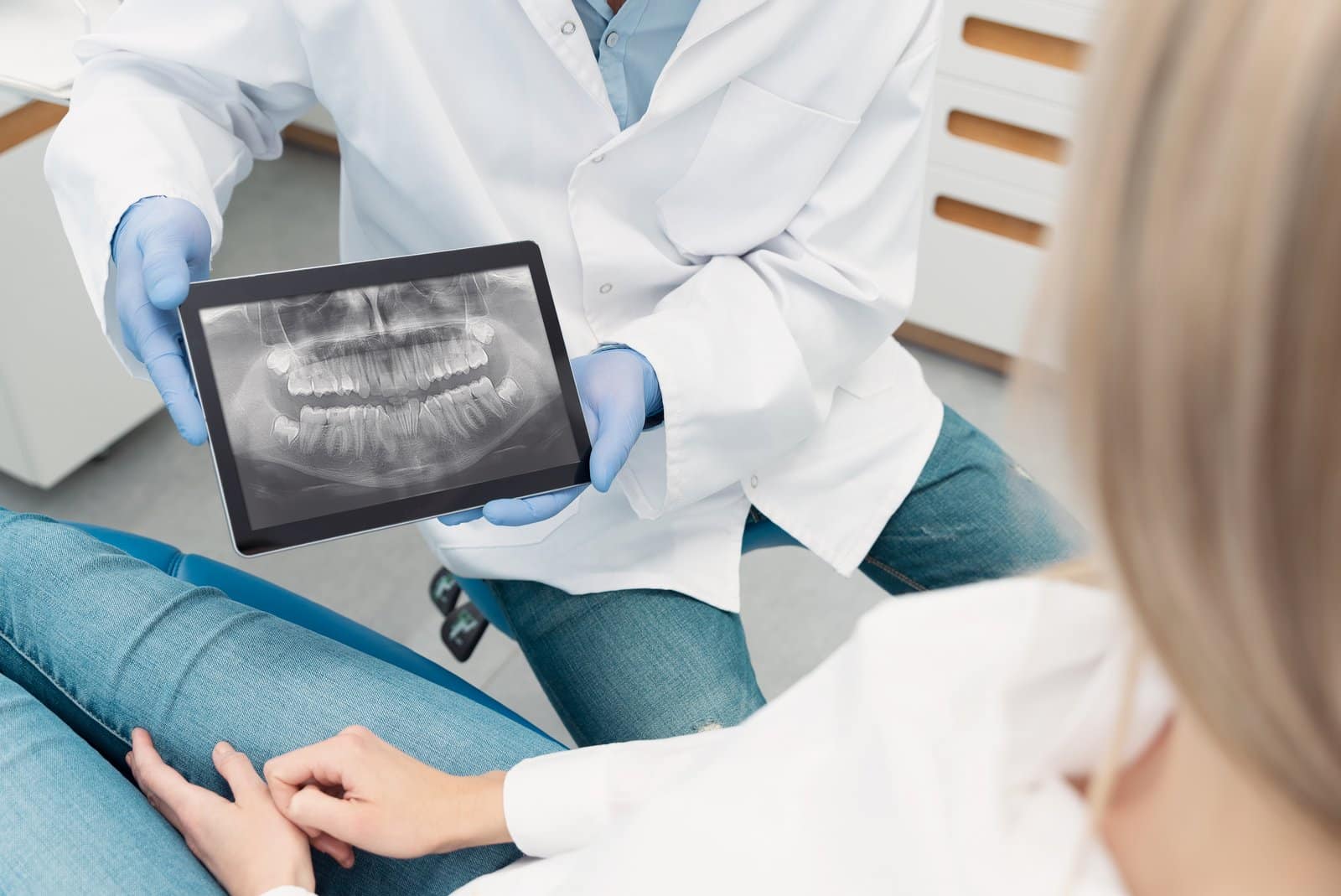
What happens at your first orthodontist appointment? It is an assessment and a conversation, not the start of treatment. You should leave knowing what is happening with your bite, whether anything needs doing, what the realistic options are, and roughly what each involves. Nothing is fitted on the day unless you have arranged it in advance. Here is the whole visit, step by step, so nothing about it is a surprise.
Key Takeaways
- Allow about an hour. Most of it is examination, records, and discussion.
- No referral is needed. You can book an orthodontist directly.
- Nothing is glued to your teeth at a consultation unless you specifically arranged it beforehand.
- For a child assessed early, a review appointment is a normal and useful outcome, not a non-answer.
- Bring your insurance details and any recent dental X-rays. It saves a second visit.
What happens at your first orthodontist appointment, in brief
The visit follows five steps: a conversation about your concerns, a clinical examination, records, a diagnosis with your options, and a discussion of cost. Each step is explained below, starting with what to do before you arrive.
Before you arrive
Two things save time. First, complete the new patient paperwork in advance if it is sent to you, so the appointment is spent on your teeth rather than on forms. Second, bring three items: your insurance information, a list of any medications, and any dental radiographs taken in the last six months, which your dentist can usually forward directly.
If you are nervous, say so when you book. It is common, it changes nothing about the outcome, and it does change how the appointment is run.
Step 1: The conversation, before anything else
A good first appointment starts with questions, not with an examination. What bothers you about your smile? Whether anything is uncomfortable. Whether you have difficulty biting or chewing. Whether you grind your teeth, or have jaw joint noises or pain. What you are hoping to change.
This matters more than it sounds. Two people can have almost identical bites and want completely different things, and a plan built without knowing which you are is a plan built for someone else.
For a child, this is also where habits come up: thumb sucking, mouth breathing, snoring, and how the adult teeth have been coming through.
Step 2: The clinical examination
The orthodontist examines how your teeth meet when you bite together, not just how they look from the front. That includes the relationship between the upper and lower arches, crowding or spacing, the midlines, any crossbite where teeth meet the wrong way round, and how the front teeth overlap.
They will also check the health of the gums and the supporting bone, look at the jaw joints and how the jaw moves, and assess the soft tissues. In children, they check which teeth have erupted against what would be expected for that age.
Step 3: Records
You cannot plan orthodontic treatment from what is visible in the mouth, because most of what matters is under the gum. Records usually include:
- A panoramic radiograph, showing all the teeth, the roots, any unerupted or missing teeth, and the jaw joints.
- A cephalometric radiograph in many cases, a side view used to measure how the jaws relate to each other. This is what distinguishes a problem with tooth position from a problem with jaw position, and the two are treated very differently.
- A digital scan or impressions, producing a three-dimensional model of your bite.
- Photographs, inside and outside the mouth, as a baseline to compare against later.
Scans have largely replaced the tray of impression material most adults remember.
What each record is for
|
Record |
What it shows |
Why the plan needs it |
|---|---|---|
|
Panoramic radiograph |
All teeth, roots, unerupted and missing teeth, jaw joints |
Finds what is not visible in the mouth |
|
Cephalometric radiograph |
Side view measuring how the jaws relate |
Separates a tooth problem from a jaw problem |
|
Digital scan or impressions |
Three-dimensional model of the bite |
The plan is designed on it |
|
Photographs |
Baseline inside and outside the mouth |
Comparison against progress later |
|
Clinical exam |
Gums, bone, joints, jaw movement |
Establishes whether it is safe to start |
Step 4: Diagnosis and options
The orthodontist explains what they found, ideally showing you the images rather than describing them. You should hear what the actual issue is, whether it is dental or skeletal, what the treatment options are, roughly how long each would take, and what happens if you do nothing.
That last one is a fair question to ask directly. Some bite issues cause measurable problems over time through uneven wear, difficulty cleaning, or joint loading. Others are cosmetic. Knowing which category you are in should inform the decision. The American Dental Association has general background on how orthodontic appliances work.
For a child assessed early, the most common outcome is monitoring. The American Association of Orthodontists recommends a first evaluation by about age seven, and most children seen then need nothing yet. Being told to come back in a year is a real result, not a fudge.
Step 5: Cost and payment
Orthodontic fees are quoted for the whole course of treatment rather than per visit. A comprehensive fee should cover the records and imaging, the appliances, every adjustment appointment across the full treatment, repairs, and the retainers at the end. Retainers and refinements are the two items most often left out of a lower-looking quote, so ask specifically.
Where a dental plan carries an orthodontic benefit, it is normally a lifetime maximum rather than an annual one, so it does not reset. Most practices spread the balance across the months of treatment. Flexible spending and health savings accounts can generally be used. WOW! Smiles publishes its insurance and finance information and payment options, and also participates in Denti-Cal.
Ask for the fee in writing with the inclusions listed. It is the only way to compare two quotes.
What does not happen at a first appointment?
Knowing what happens at your first orthodontist appointment also means knowing what does not. Braces are not usually fitted. The records taken at the consultation have to be studied and the plan designed before appliances go on, which typically means a second appointment two to four weeks later. Some practices offer to bond at the first visit if it is arranged in advance and the mouth is healthy, but it is a scheduled decision rather than something that happens spontaneously.
Teeth are not extracted, and no irreversible treatment is carried out. You are also not obliged to decide anything on the day. A plan for one to two years of treatment deserves more than a car park decision.
Questions worth asking
- Is my problem dental or skeletal, and how do you know?
- What are my options, including doing nothing for now?
- What does the fee include, and what is excluded?
- How long, realistically, and what would extend it?
- What do you need from me for it to finish on time?
- What does retention involve afterwards?
- Who will I actually see at each visit?
Frequently asked questions
Do I need a referral to see an orthodontist?
No. An orthodontist is a dental specialist you can book directly. Referrals are common because a general dentist often notices a bite problem at a check-up, but they are a courtesy rather than a requirement.
How long does the first appointment take?
Usually around an hour. Most of that is the examination, records, and the discussion afterwards. Completing your paperwork in advance and bringing recent radiographs shortens it.
Will I get braces on the first visit?
Generally not. The records have to be studied and the plan designed first, which typically means appliances are fitted two to four weeks later. Some practices offer same-day bonding when it is arranged beforehand, and the mouth is healthy.
Does the first appointment hurt?
No. It is an examination, photographs, a scan and radiographs. Nothing is drilled, extracted, or bonded. Some people find the scan slightly awkward, and it is not painful.
What should I bring?
Insurance details, a list of any medications, and any dental radiographs taken in the last six months, which your dentist can usually send over directly. If a child is being seen, bring whoever makes the decisions with you.
At what age should my child be assessed?
By about age seven, per the American Association of Orthodontists. Most children seen at that age need nothing yet and are simply reviewed. The value is in identifying the smaller group where treating during growth avoids a much larger correction later.
Why do I need X-rays?
Because most of what determines treatment is not visible in the mouth. A panoramic radiograph shows the roots and any unerupted or missing teeth, and a cephalometric radiograph measures how the jaws relate to each other, which is what separates a tooth position problem from a jaw position problem.
What if I am told I do not need treatment?
That is a legitimate outcome and a sign of a careful assessment. Where a bite functions well and the concern is minor, saying so is the honest answer. In children, monitoring is often the right plan because growth may change the picture.
Can I get a second opinion?
Yes, and it is entirely reasonable for a commitment lasting one to two years. Take your written plan with you. No reasonable orthodontist objects, and being able to compare two plans usually clarifies which one actually addresses your concern.
What happens after I say yes?
Appliances are fitted at a subsequent appointment, then you attend for adjustments every four to eight weeks. At the end, the appliances come off, and retainers are fitted, and retention continues long term. See our pages on braces, Invisalign and aftercare for what each stage involves.
Dr. Rael Bernstein founded WOW! Smiles and completed his orthodontic specialty residency at the State University of New York at Buffalo, where he was later a clinical assistant professor in the orthodontic department. He is joined by Dr. Naveen, Dr. Wendan Li, Dr. Eric Wu, and Dr. Sierra Burick; you can read about the team on our doctors page.
Ready to book a first appointment? WOW! Smiles treats patients of all ages across Northern California, with offices in Monterey, Napa, Pittsburg, Salinas, Santa Rosa, Soledad, Ukiah, Vallejo and Watsonville. Call (844) 900-4969 or contact us to arrange a consultation. New patients can read what to expect on our new patients page.