
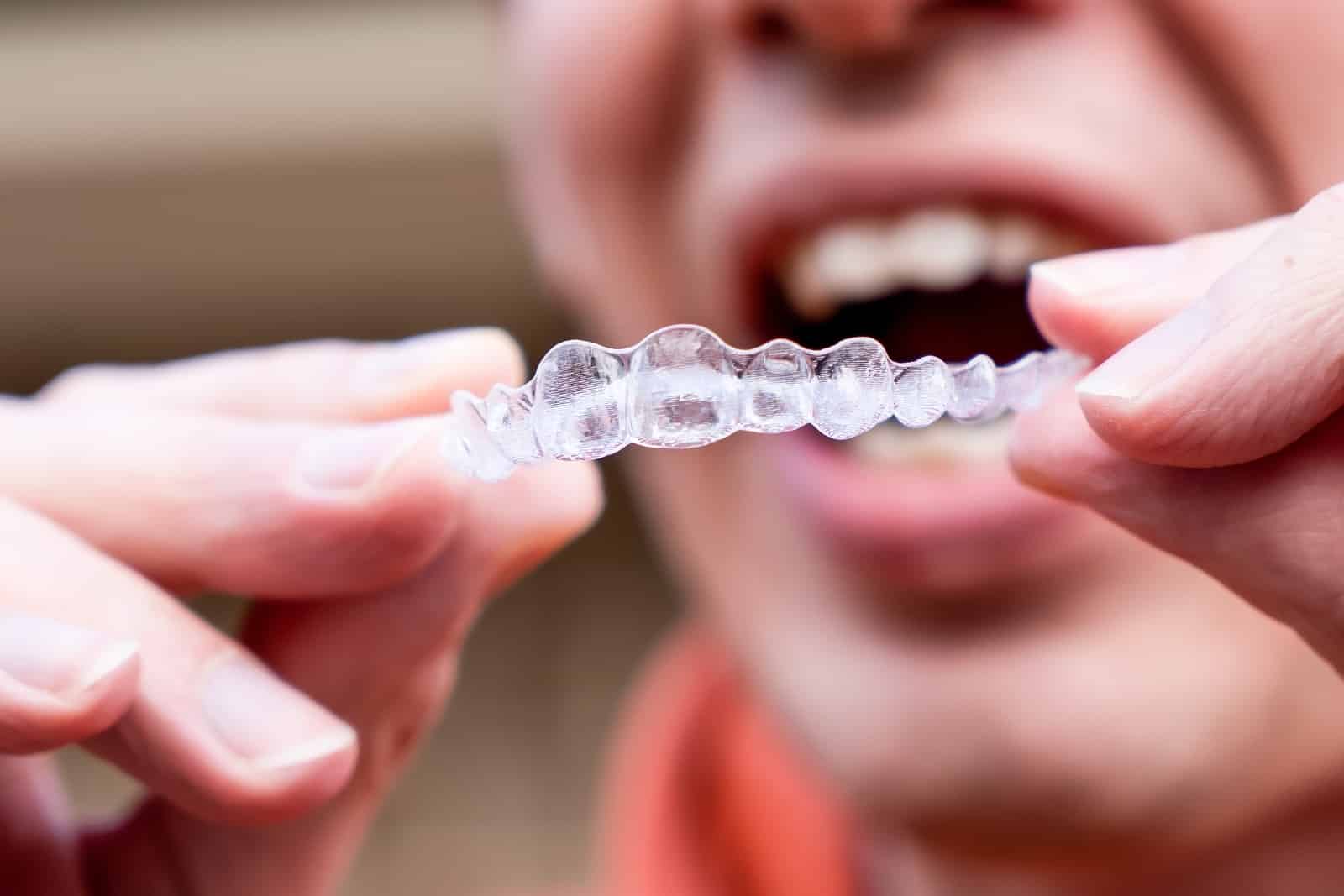
If you want straighter teeth but the thought of metal brackets is what has kept you from starting, learning how to fix crooked teeth without braces opens up real options. Clear aligners move teeth using the same physics as braces, with no visible hardware, and they handle the majority of mild to moderate cases. Other approaches, including clear ceramic braces, palatal expanders for growing children, and cosmetic bonding or veneers for teeth that are merely chipped or slightly rotated, cover the rest. What follows is an honest look at which option matches which problem, and where each one stops working.
Key Takeaways
- Clear aligners are the main way to straighten teeth without braces, and they treat most mild to moderate crowding, spacing, and rotation.
- Aligners only work if you wear them at least 22 hours a day, so they suit disciplined adults and teens better than younger children.
- Severe crowding, large bite discrepancies, and teeth that need major rotation still respond best to fixed braces.
- Veneers and bonding change how teeth look without moving them, which is a cosmetic answer to a cosmetic problem, not a fix for a bad bite.
- Mail-order aligners skip the diagnosis, and a diagnosis is the part that keeps you safe. Get a free exam first: call (844) 900-4969.
Can crooked teeth actually be straightened without braces?
Yes, for most people. What cannot be skipped is the force.
Teeth move because something applies steady, gentle pressure to them over months. The ADA’s MouthHealthy guide to braces describes braces as realigning teeth by applying exactly that pressure, and it lists removable aligners under the supervision of a dentist or orthodontist as another way to treat the same problems. The question is never whether you can avoid force. It is which appliance delivers that force best for your particular case.
Crooked teeth are not only a looks problem. Cleveland Clinic’s overview of malocclusion notes that a misaligned bite can make teeth harder to clean, which raises the risk of decay and gum disease, and can affect chewing and speech. That is the reason to treat it, and it is also the reason the diagnosis matters more than the appliance.
How do clear aligners fix crooked teeth?
Clear aligners are a series of custom trays, each one shaped slightly closer to the finished result than the last. You wear each set for one to two weeks, then move to the next, and the teeth follow.
Treatment starts with a digital scan rather than a mouthful of putty. The orthodontist plans every movement in software, then the trays are manufactured to that plan. Small tooth colored attachments are often bonded to a few teeth, so the plastic has something to grip, which is how aligners manage rotations that older systems could not.
The American Association of Orthodontists is clear that each tray is worn at least 22 hours a day, typically for about a week before you move to the next one. You take them out to eat, to drink anything other than water, and to brush. That is the whole trade: no visible hardware, in exchange for genuine discipline.
Our Invisalign page covers how the system works in practice, and what is Invisalign is the plain language version if you are starting from zero.
Which option is right for which problem?
|
Option |
What it treats well |
What it will not fix |
Roughly how long |
|---|---|---|---|
|
Clear aligners |
Mild to moderate crowding, spacing, rotation, mild bite issues |
Severe skeletal bite problems, large movements |
Often 6 to 24 months |
|
Clear ceramic braces |
Everything metal braces treat, with a lower profile look |
Nothing braces cannot treat, but brackets can chip |
About 2 years on average |
|
Metal braces |
Severe crowding, complex bite correction, big rotations |
Nothing, but they are visible |
About 2 years on average |
|
Palatal expander |
A narrow upper jaw in a growing child, crossbite |
Anything in an adult whose jaw has fused |
Several months |
|
Bonding or veneers |
The look of small chips, gaps, and slight rotation |
The bite itself, gum health, tooth position |
1 to 3 visits |
|
Retainer alone |
Holding teeth that have already been straightened |
Moving teeth that were never treated |
Ongoing |
Those timings are averages, not promises. Cleveland Clinic’s guide to dental braces puts a typical braces course at about two years, with straightforward cases finishing in under 12 months and complex ones running as long as three years.
The pattern in that table is worth naming. Appliances move teeth. Cosmetic dentistry changes how teeth look. Only one of those two things improves how your bite functions.
What about veneers and bonding?
They are legitimate treatments and a poor substitute for orthodontics.
Bonding adds tooth colored composite to reshape a tooth. Veneers are thin custom shells cemented to the front surface, described in the ADA’s MouthHealthy guide to veneers. Both can close a small gap or mask a slightly turned tooth in a couple of visits, which is genuinely appealing if the problem is one front tooth and the bite underneath is healthy.
The catch is that veneers usually require permanently reducing enamel, so it is not a reversible decision. And neither treatment corrects a crossbite, an open bite, or crowding that traps plaque. If your teeth are crooked enough that cleaning them is hard, covering them does not solve the underlying problem. Many patients get the best of both by aligning the teeth first and then, if they still want a cosmetic refinement, doing that afterward on teeth that are already in the right place.
How to fix crooked teeth without braces: the steps
- Get a real diagnosis first. A free orthodontic exam gives you photographs, X-rays, and a digital scan, and tells you whether your case is an aligner case at all. Plan on about an hour.
- Review the digital treatment plan. You see the projected sequence of movements before you commit. This usually comes back within a week or two of the scan.
- Start your first trays and attachments. Attachments are placed, and you receive your first set, with instructions on the 22-hour rule. One appointment.
- Change trays on schedule and check in. Each set is worn for one to two weeks, with progress visits every six to ten weeks so the orthodontist can confirm the teeth are tracking the plan.
- Finish, then retain. Teeth drift for life without retention, and Cleveland Clinic is blunt that anyone finishing orthodontic treatment needs a retainer to stop the teeth sliding back. Our aftercare page explains what wearing it actually looks like long term.
Are mail order aligners a safe way to skip braces?
This is the one place to be genuinely cautious.
Direct-to-consumer aligner companies ship trays based on an impression you take yourself, with no X-rays and often no in-person examination.
That skips the two things that catch problems: imaging that shows root position and bone level, and a clinician who can see gum disease or an untreated cavity before force is applied to those teeth. Moving teeth in a mouth with active gum disease can cost you bone you do not get back.
The AAO’s aligner guidance is explicit that an orthodontist is the person best qualified to decide whether aligners, braces, or a combination suit your case. That is a judgment no mail order kit makes. If cost is what is pushing you toward a mail order kit, ask about financing instead. WOW! Smiles offers interest-free monthly plans with no down payment, laid out on our insurance and finances page.
Why choose WOW! Smiles for aligner treatment?
WOW! Smiles is a Northern California orthodontic group founded by Dr. Rael Bernstein, who completed his orthodontic residency at the State University of New York at Buffalo and later served as a clinical assistant professor there. Dr. Eric Wu, who reviewed this article, trained at the University of Pennsylvania and completed his orthodontic residency at the University of Pittsburgh, and has spent more than 20 years focused on clear aligner treatment and digital smile design.
You will find offices in Monterey, Napa, Pittsburg, Salinas, Santa Rosa, Soledad, Ukiah, Vallejo and Watsonville. Exams and consultations are free, financing is interest-free, and you can meet the whole team on our doctors page or see finished cases in our before and after gallery.
Contact WOW! Smiles:
- Phone: (844) 900-4969
- Email: info@wowsmiles.com
- Book online: wowsmiles.com/contact-us
Frequently asked questions
Can you straighten teeth without braces at any age?
Adults can absolutely be treated, and aligners are the most common adult choice. What changes with age is that the jaw no longer grows, so appliances that widen the palate work only in children. Tooth movement itself still works at any age with healthy gums and bone.
How long does it take to fix crooked teeth with clear aligners?
It depends on how far the teeth need to travel, and the AAO notes that the number of trays and the total time vary with the movements your case needs. Minor front tooth corrections finish fastest. Your orthodontist gives you a specific range once the digital plan is complete.
Do clear aligners hurt?
You feel pressure and mild soreness for a day or two after switching to a new set, which is a sign the trays are working. Most people describe it as tightness rather than pain, and it fades as the teeth settle.
Can aligners fix severe crowding?
Sometimes, but this is the honest limit of the technology. Severe crowding, large rotations and significant bite discrepancies are often faster and more predictable with fixed braces. If your case is borderline, an orthodontist will tell you which appliance gets a better result.
Are ceramic braces less noticeable than metal?
Yes. Ceramic brackets are tooth colored and blend with your enamel, which our clear braces page explains in detail. They are more fragile than metal, so they suit adults and older teens better than active younger children.
Will veneers fix my bite?
No. Veneers change the appearance of the front surfaces of teeth. They do not move teeth, correct a crossbite, or improve how your upper and lower arches meet.
What happens if I do nothing about crooked teeth?
Crowded and overlapping teeth are harder to clean, which raises the risk of decay and gum problems, and an unbalanced bite can wear teeth unevenly over time. Whether that matters for you depends on your specific bite, which is what an exam determines.
Do I have to wear a retainer afterwards?
Yes, indefinitely. Teeth move throughout life, and retention is the only thing that holds the result. Most patients move to nights only after an initial full-time period.
Can teenagers use clear aligners instead of braces?
Many can. The deciding factor is compliance rather than age, because a tray sitting in a backpack is not moving anything. Our Invisalign for teens page covers how teen plans differ.
Is a dentist referral needed to start?
No. You can book an orthodontic exam directly at WOW! Smiles, and the exam is free.
How much does aligner treatment cost?
Fees depend on how complex the case is and how long treatment runs, so a firm number comes at the consultation rather than over the phone. Our Invisalign cost page explains what moves the number, and interest-free monthly financing is available.
Ready to see which option fits your smile?
The fastest way to find out whether you can skip braces is to have someone look at your actual teeth. The exam is free, the digital scan takes minutes, and you leave knowing exactly which treatments would work for you and what each one involves. Request your free consultation or call WOW! Smiles at (844) 900-4969.